DIY barn door tracker for astrophotography. Includes the microcontroller code and presentation slides from my talks at Starnights and VVS Scheldeland.

DIY Barn door tracker
What is it?
A barn door tracker, also known as a "volgplank" in Dutch, is a simple device used in astrophotography to counteract the Earth's rotation. It's designed to allow a camera or telescope to capture long-exposure images of the night sky without stars appearing as streaks due to Earth's movement.

The code that makes the project "tick"
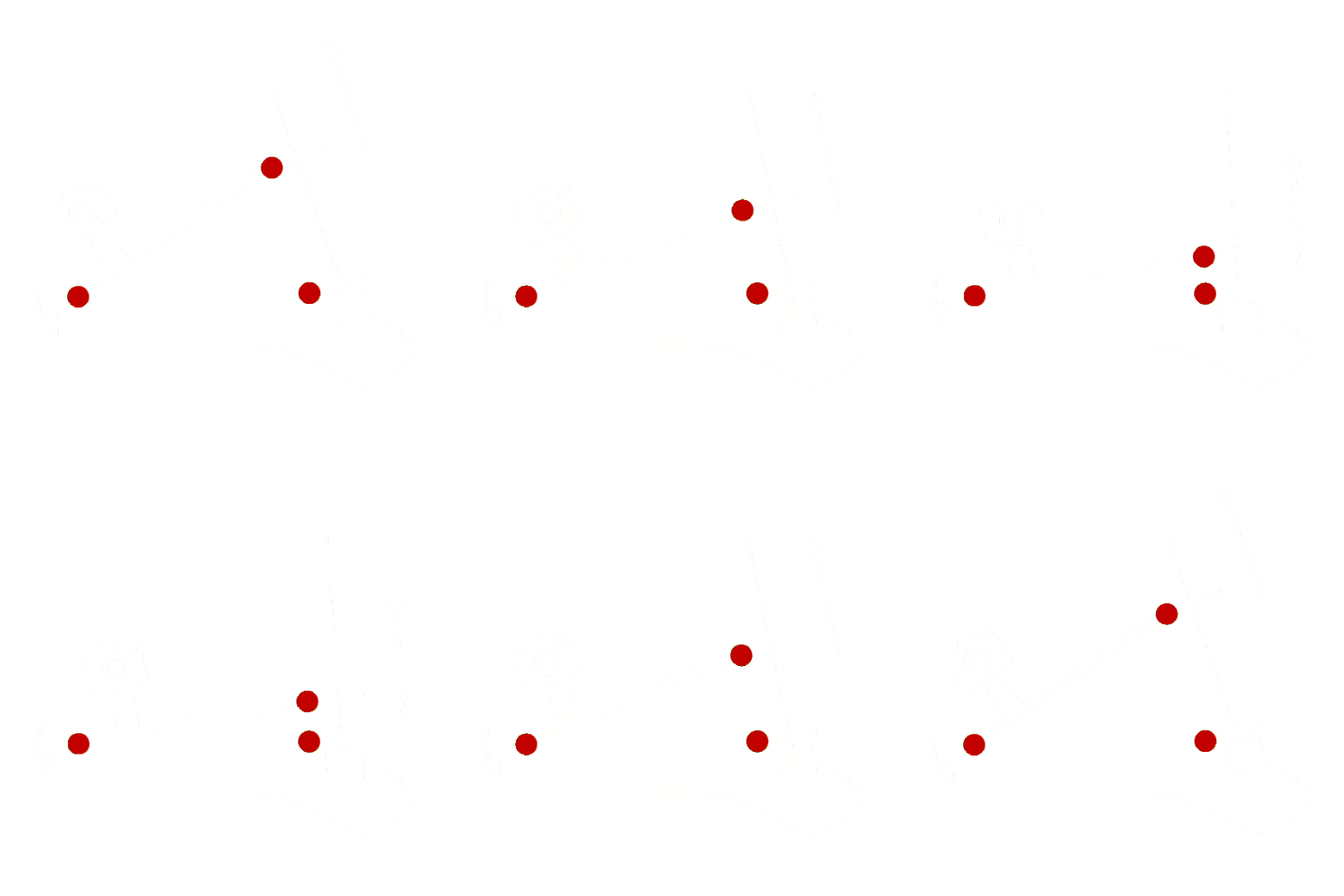
The barn door tracker operates using a stepper motor, which advances a set distance with each step. This means someone needs to send step commands at the correct interval. This seemingly simple task took more work than expected. For instance, issuing step commands at a constant interval doesn't result in a uniform rotation due to the barn door tracker's unique geometry. When to step is calculated by tiny microcontrollers, such as the Arduino Nano and Xiao Seed BLE. These microcontrollers run code written in CircuitPython and C++ (Arduino variant), which you can access in the linked repository.
Microcontroller Code
Kinematica
The barn door tracker consists of two hinged boards, with one board acting as a fixed
base and the other as a movable lid or door. The camera or telescope is mounted on the
movable lid. A hinge connects the two boards at one end, and the other end of the
movable board has a threaded rod.
As the Earth rotates, a motor makes the threaded rod turn. This causes the movable lid
to open at a rate that matches the Earth's rotation. Because the camera/telescope is
mounted on the movable lid, it now also turns. This allows for
long-exposure photography without star trailing.
Presentation slides
This presentation explains the purpose of my tracker, and what makes it tick on the inside. It was used for my talks at Starnights and VVS Scheldeland.
Open fullscreen